Why Employer Brand Has To Start From The Inside with Amy Parker (Valtech)

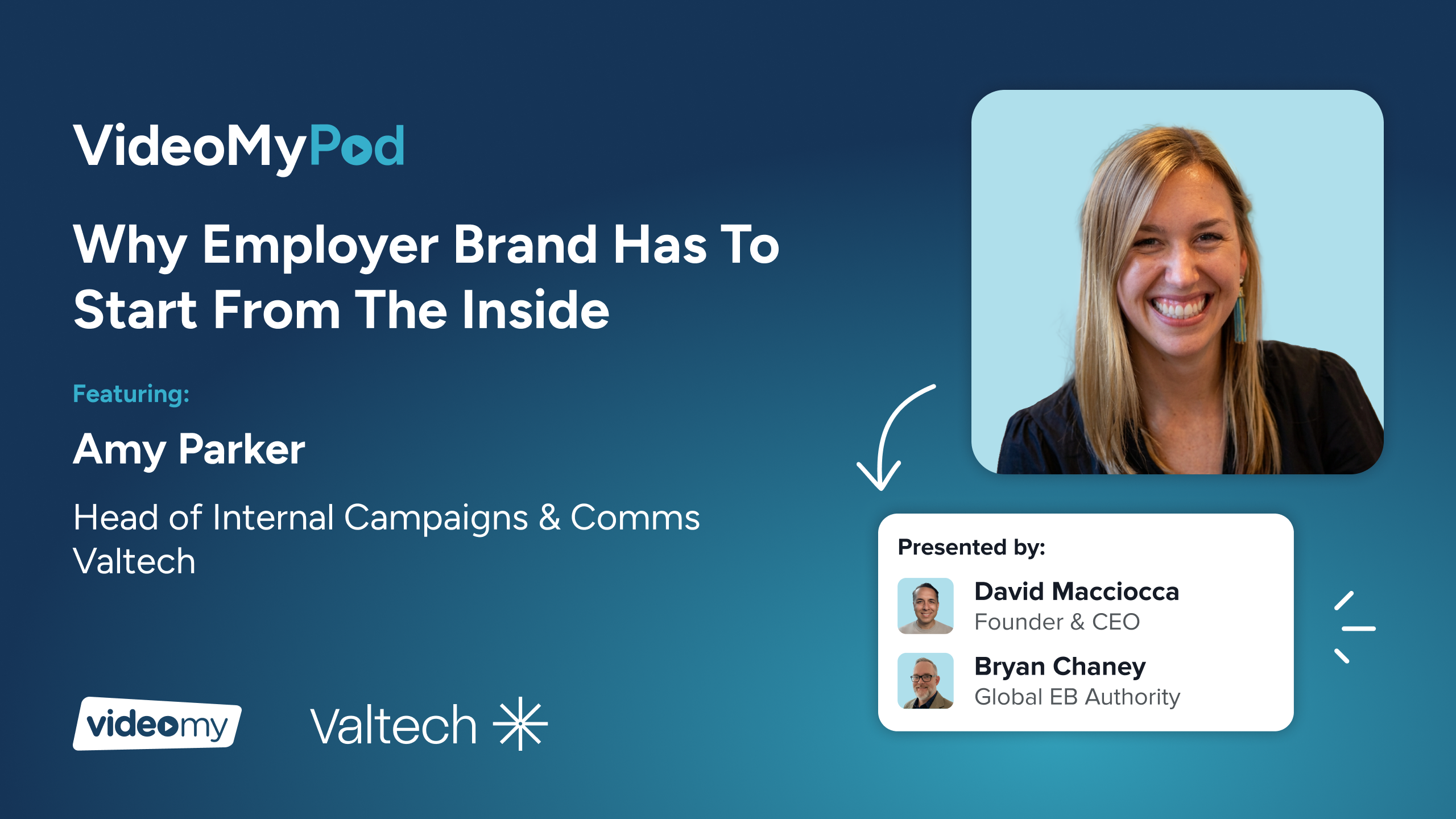
Amy Parker spent seven years building employer brand through two rebrands and an acquisition, scaling the function from the US to the Americas and then globally. About a year and a half ago, she moved into a new role as head of internal comms at Valtech. On the VideoMy Pod, she explained why employer brand and internal comms belong much closer together than most companies keep them.
Pausing to Define Who You Are
When Kin + Carta merged with Valtech, two similar-sized companies became one 6,000-person global organisation. "I led about 80 interviews across the business of folks I'd never met," Amy says, trying "to understand what are the sparks of each organisation and how does that create one cohesive story for our people."
With several cultures under one name, the merger was the moment to decide: "Let's actually make the definition of who we are and why we're different, why people join and why people stay."
The answer was the same at both companies. "If you ask, 'Why are you here?' It's always the people." That, along with an entrepreneurial spirit where "you were empowered to drive your career," became the foundation.
What Moving to Marketing Taught Her
Amy started as a recruiting coordinator in TA. When her growth there hit a ceiling, a new CMO who "loved the people story" brought her into marketing.
"I had to learn so much about what marketers measure, how they talk," she says. With a stretched team around her, she learned the tools herself: "I became a digital marketer very quickly, which I think made me a better employer brander, too, because I could do it myself and execute and measure and make the changes."
Bringing Campaign Thinking to Internal Comms
Amy says the most valuable thing she brought over from employer brand is segmentation. "You're constantly thinking about who am I trying to reach, how can I target to get the segment and get them the information they need. Oftentimes internal comms is just blasts of information."
Her internal comms runs on three campaign streams. "Unify" covers strategic leadership comms. "Optimise" is about developing people And "engage" celebrates "the moments of belonging and culture that exist in our organisation." The streams feed each other, with employee stories often appearing in the middle of strategy updates at town halls.
Finding those stories across a global, mostly remote workforce takes "a lot of sleuthing on our digital channels, joining as many communities as I can," and messaging employees directly: "Hey, that was so awesome. Can we build something around this?"
Measuring Usefulness, Not Just Opens
Starting with very little data, Amy went beyond open rates and added a survey to every email asking how useful it was, "so we can not only see if someone's looking at the content, but is it helping them do their job." Every campaign also ties back to the twice-yearly engagement survey.
Sharing Data Between Both Functions
Amy sees a big gap that most companies haven't filled. "Employer brand gets such good insight from the talent market of how a role or an offering is landing. Internal comms gets so much insight of how a strategy or a message is landing. If you marry those data points together, you can really inform one another."
"You can't sell something and then once someone comes in they're communicated to in a different way or they experience something totally different."
Her advice to her younger self comes from a lesson one of her first managers taught her: "You can't fill a leaky bucket." Have the hard conversations with leaders earlier, because if you can't engage people inside the business, you'll struggle to engage them outside it.
🎥 Watch on YouTube
🎧 Listen on Spotify