The Graduate Recruitment Marketing Playbook (ANZ)

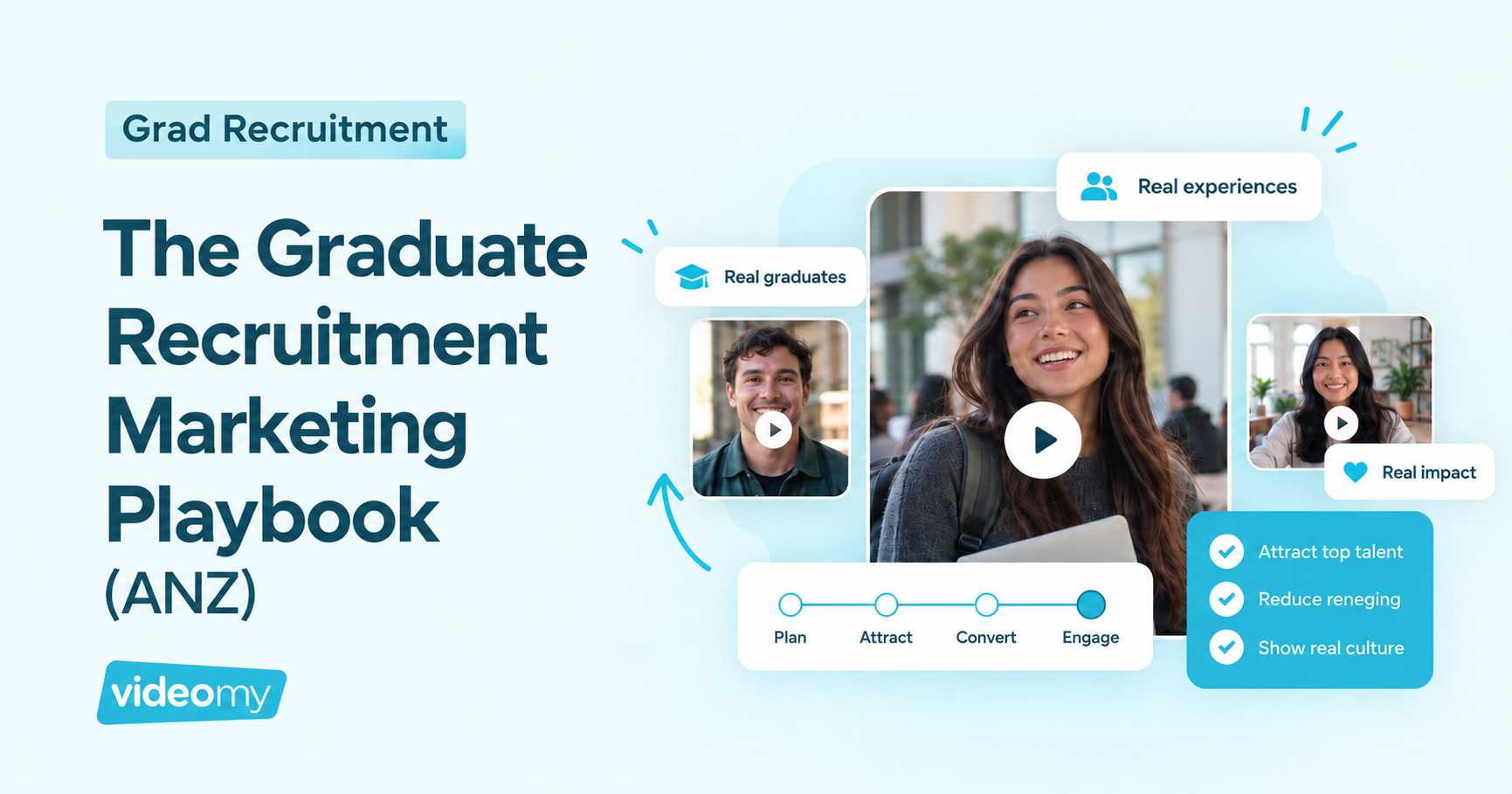
Graduate recruitment marketing is the work of attracting, converting and keeping the right graduates through a fixed annual cycle, from first awareness at university through to day one of the program.
In Australia and New Zealand the cycle is long: applications typically open between February and April, offers go out mid-year, and graduates often don’t start until the following February. That means employers have to win candidates’ attention in a crowded window, then keep them engaged for up to nine months after they accept. The employers who do this best use authentic, peer-led content at every stage, because that is what graduates trust.
This playbook is for graduate program managers, early careers leads and employer brand teams in ANZ. It covers the annual cycle, what graduates actually want, the content you need at each stage, how to reduce reneging and how to measure success.
Why is graduate recruitment getting harder?
Graduate teams face a squeeze from both sides: more competition for attention, and candidates who are more selective about where they apply and whether they turn up.
- Costs are rising. AAGE’s Employer Survey report shows grad attraction costs are up 34% year on year, putting a real squeeze on the bottom line.
- Graduates are more selective. Graduates research employers thoroughly before applying and weigh career progression, training and culture heavily. In AAGE’s 2026 research, 50% of candidates said career progression was one of the three most important elements of a graduate program, 41% prioritised the quality of training and development, and 35% valued company culture.
- Reneging is a real cost. Graduates who accept and then drop out before starting leave gaps that are hard to fill at short notice. Grad reneg rates sit at around 17%, although up to 35% admit they would accept an offer and keep looking for opportunities.
- Employers sound the same. Most graduate campaigns promise “rotations, development and a great culture”. Without proof, every employer looks interchangeable.
The competition is global, too. In the UK, the Institute of Student Employers recorded an average of 140 applications per graduate vacancy, the highest in the three decades it has tracked this. Volume is not the problem for many employers. Attracting the right applicants, and keeping them, is.
What do graduates actually want from an employer?
Today’s graduates are not chasing the corner office. Deloitte’s 2025 Gen Z and Millennial Survey found that only 6% of Gen Zs say their main career goal is to reach a senior leadership position, with the generation balancing money, meaning and wellbeing in their career decisions.
In practice, graduates want to know:
- Will I grow? Real examples of where past graduates have ended up, and what the rotations actually involve.
- Will I be supported? Who their buddy, mentor and manager will be. AAGE found 92% of employers allocate graduates a buddy and 70% provide a formal mentor, so simply having these is not a differentiator. Showing them is.
- Will I fit in? What the culture and people are really like, from people their own age.
- Is the flexibility real? How hybrid and flexible arrangements work day to day.
- Does the work matter? The purpose behind the organisation, told through real projects.
Where do graduates research employers?
Graduates do their research on social platforms and graduate sites long before they visit your careers page. In a Zety survey of US Gen Z workers, 95% said a company’s online presence affects their decision to apply. In ANZ, the key channels are:
- Graduate job platforms such as Prosple, GradConnection, SEEK and university careers portals.
- Social video on TikTok, Instagram and YouTube, where they look for unfiltered views of what a job is like.
- LinkedIn, particularly content shared by current graduates and recent alumni.
- Peers and review sites, including friends, student societies and Glassdoor.
- Your careers site, usually as a final check once they are already interested.
The common thread is peer voices. LinkedIn found people are 3x more likely to trust company information from employees than from the CEO. For graduates, the most trusted voice of all is someone who was in their shoes a year or two ago.
The ANZ graduate recruitment cycle (and what content you need at each stage)
Most large ANZ graduate programs follow a similar annual rhythm although timings do vary by employer and industry, so adjust this to your own program.
Stage 1: Plan and build (August to January)
This is when the campaign is won or lost. Use this window to review last season’s results, refresh your messaging and capture content before the rush.
- Film Meet-the-Grads videos with your current cohort while they are settled in and enthusiastic.
- Capture day-in-the-life content for each rotation or stream.
- Record career journey stories from graduates two to five years on, to show where the program leads.
- Update graduate platform profiles and careers pages with fresh video.
Stage 2: Attract (February to April)
Applications open. Your job is to stand out on crowded graduate platforms and convert interest into quality applications.
- Publish an always-on feed of graduate stories on your careers page and graduate platform profiles.
- Run short-form peer videos on social channels, answering the questions students actually ask.
- Equip campus events and webinars with video your current grads have made.
- Use "why choose us" clips that show proof, not promises: real rotations, real projects, real people.
Stage 3: Assess (April to June)
Candidate experience matters here. Many graduates are juggling multiple processes, and a confusing or impersonal process loses good people.
- Explain the process with short videos: what each stage involves, what you look for, tips for video interviews and assessment centres.
- Use friendly recruiter and graduate videos to reduce anxiety and show the human side of the process.
Stage 4: Offer (May to July)
Graduates often hold multiple offers. Personal, human contact helps them choose you.
- Send personalised welcome videos from future managers or teams with the offer.
- Share “what happens next” content so they know what to expect between now and day one.
Stage 5: Preboard (July to February)
This is the longest and riskiest stage, and the one most employers neglect. Months of silence between acceptance and start is when graduates are most likely to renege.
- Run an offer-to-start nurture series: a short video every few weeks from the current cohort, buddies, managers and leaders.
- Introduce their buddy and mentor on video before day one.
- Answer practical questions (first week, dress code, getting there, pay dates) on video.
Stage 6: Review (March to June)
Once the new cohort has started, run a structured retrospective while the data is fresh, and plan improvements for the next season.
How do you reduce graduate reneging?
Reneging usually happens because the connection fades, a competing offer arrives or doubts creep in during a long gap. The fix is to keep graduates emotionally invested from offer to day one:
- Make the offer personal. A video message from the future manager or team lands far better than a PDF.
- Keep in touch regularly. Plan touchpoints every three to four weeks, not just a welcome pack and a start date.
- Use peer voices. Current graduates are the most persuasive people to reassure an incoming cohort.
- Introduce people early. Meeting their buddy, mentor and fellow graduates (even on video) builds belonging before day one.
- Answer the worries. Short videos addressing common concerns reduce the uncertainty that leads to second thoughts.
- Track it. Measure reneging by stream and source, and ask those who renege why.
What content should be in your graduate content library?
A strong graduate program has a reusable library rather than one hero video. Aim for:
- Meet-the-Grads videos: current graduates introduce themselves and the program in their own words.
- Day-in-the-life snapshots: one for each stream, rotation or location.
- Why choose us clips: proof-led reasons to join, told by graduates and managers.
- Career journey stories: alumni who have progressed through the business.
- Process explainers: how to apply, what to expect, tips for each stage.
- Offer-to-start nurture series: welcome, buddy introductions, practical FAQs, countdown content.
- Diversity and inclusion stories: graduates from different backgrounds, disciplines and locations sharing their experience.
Employee-generated video makes this library realistic to build and refresh every year. See our guide on how to create engaging and authentic employee stories.
How do you measure graduate recruitment marketing?
- Attraction: applications per vacancy, application quality, and source of applicants by channel.
- Diversity: representation across the funnel, not just at application.
- Conversion: progression rates through each assessment stage.
- Offer acceptance rate and reneging rate between acceptance and start.
- Cost per hire: total attraction and selection spend divided by graduates starting.
- Candidate experience: satisfaction scores at each stage.
- Early retention: graduates still in the program after 12 months.
How VideoMy helps early careers teams
VideoMy helps graduate teams build a full season of authentic, peer-led content without agency costs or production headaches. Current graduates, buddies and managers record short videos on their phones using guided prompts, and brand-safe templates and approvals keep everything on-brand. Content can be published to a Story Feed on your careers site and shared across graduate platforms and social channels, and an offer-to-start nurture series keeps incoming graduates engaged until day one.
Many teams start with a seasonal pilot timed for their attraction campaign, then expand once the results are in. See how Deloitte created 100+ videos in one week, leading to a 100% increase in applications and a 125% increase in content engagement.
Frequently asked questions
When do graduate applications open in Australia?
For most large employers, graduate applications open between February and April, with assessments running through to around June and offers made mid-year. Programs usually start the following February. Some employers now open earlier, so check your competitors’ timelines.
When should we start planning our graduate campaign?
Ideally four to six months before applications open, which means from around August for a February launch. That gives you time to review last season and capture content with your current cohort.
What is graduate reneging?
Reneging is when a graduate accepts an offer and then withdraws before starting, usually to take another offer. Long gaps between offer and start date make it a particular risk in ANZ.
How do you make a graduate program stand out?
Show rather than tell. Real stories from current graduates and alumni about rotations, support and career progression are far more convincing than generic claims that every employer makes.
What type of content do graduates trust most?
Graduates trust peer voices most: content from current graduates and recent alumni, ideally short video that shows the real experience rather than a polished corporate message.
Sources
- AAGE: Graduate programs remain critical to Australia’s future workforce, new research finds (The Future of Early Careers, 2026)
- AAGE: Candidate Survey
- AAGE: Employer Survey
- Institute of Student Employers: ISE top 10 stats of 2025
- Deloitte: 2025 Gen Z and Millennial Survey
- Zety: Gen Z Career Trends Report
- LinkedIn Talent Blog: 7 Stats That Prove Your Employees Are Your Secret Recruiting Weapon