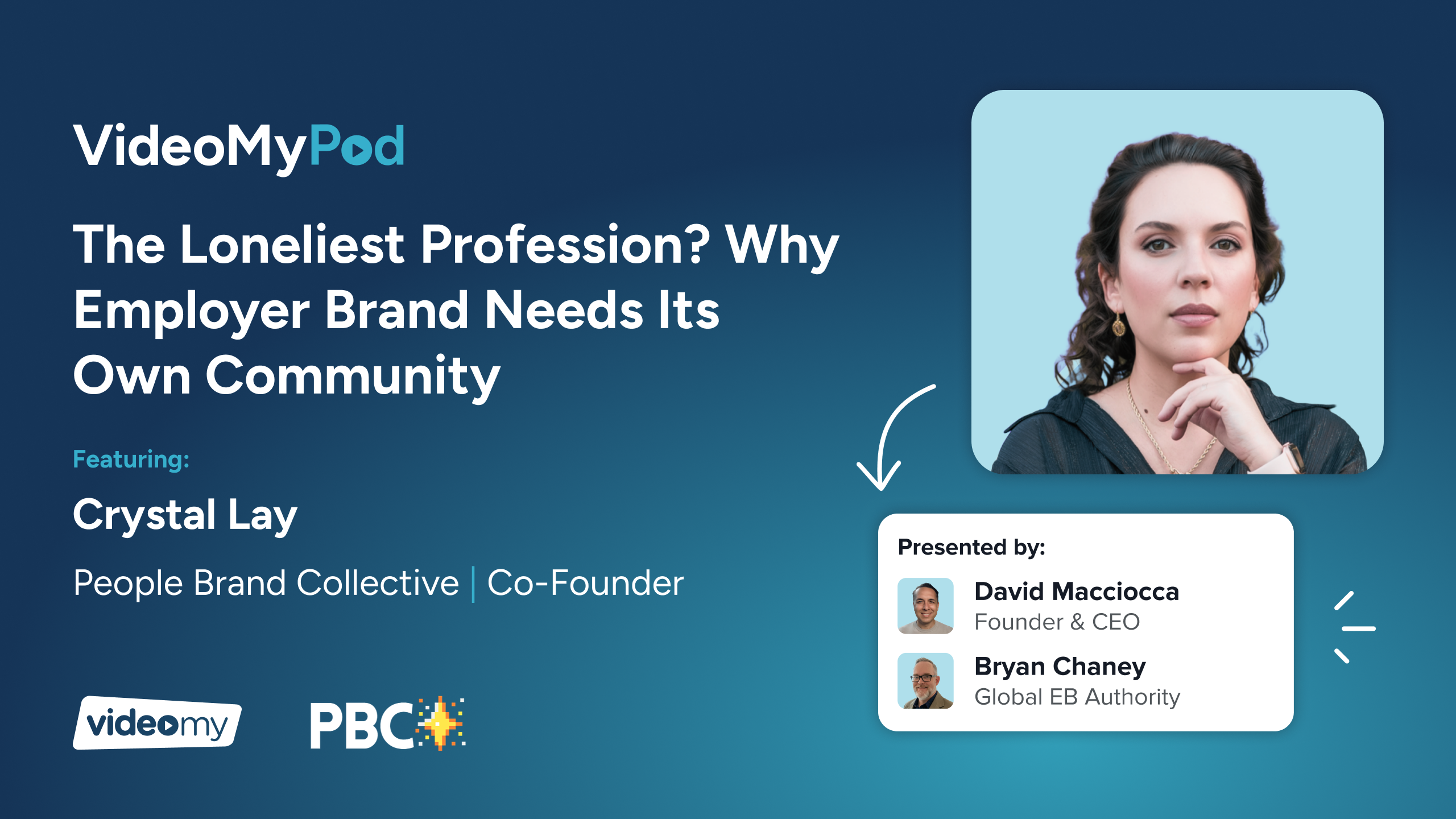
The Loneliest Profession? Why Employer Brand Needs Its Own Community with Crystal Lay (PBC)

For years, the employer branding profession felt orphaned. SHRM serves HR. IACP serves internal comms. IEEE serves engineering. But there was no community for people brand and recruitment marketing professionals. That is until Crystal Lay, Allison Kruse, and Bryan Chaney decided to build one. What started as a shared frustration became People Brand Collective (PBC), an industry association addressing a loneliness epidemic among employer branders. Her story reveals why community isn't a luxury, it's essential infrastructure for an isolated profession.
The Loneliness Epidemic in Employer Branding
"There's a SHRM that serves HR and there's IACP that serves internal comms and there's IEEE that serves engineering, but there's not really a group that serves employer branding and recruitment marketing," Crystal explains. This isn't a minor oversight. "It's a really isolating feeling."
The isolation runs deeper than professional isolation. "We are in an epidemic of loneliness," Crystal notes, grounded in psychology research. Post-pandemic, adult friendships became shallower and less frequent. Work friendships vanished for remote teams. Many employer branders work solo or in tiny teams. "They're already isolated in their job. So this gives people an outlet to build relationships that we really desperately need as people."
The Structural Problem: Teams of One
The employer branding field lags traditional marketing by a decade in team structure. "TA is a solid 10 years behind traditional marketing," Crystal says. This shows in headcount. Large companies sometimes have one or two employer branders expected to move mountains. "There were giant companies that I worked with where their marketing department was five people and you would never know it."
The "gladiator in a suit" phenomenon, the image Crystal borrows from Scandal, captures the reality. "I've got to get your support. I've got to get your cooperation. And I know you don't necessarily want to stop or slow down. But you've got to. Here's why it's important." That constant fighting is exhausting and lonely.
Equal Membership Matters
PBC deliberately built inclusivity into its DNA. Many communities tier membership (think associate members, vendor members, junior members) with different access levels. Crystal rejected that. "We don't treat anyone doing the work differently because they do it in a different type of company."
This matters because agency professionals, consultants, and vendors get systematically excluded from learning opportunities. "If you're not an in-house practitioner, you have to pay more to go to conferences. You get reduced learning opportunities. You're penalized further for being in those spaces," Crystal says. That inequity compounds for people already facing disadvantage: minorities, women, people with disabilities, neurodivergent professionals.
"It's disproportionately people who are at a disadvantage who end up in agency, consultant, and vendor roles," Crystal explains. "And then they're penalized further by not getting the same learning opportunities." PBC flipped that: everyone enters as an equal.
From Isolation to Shared Problem-Solving
The real power emerges when people recognize their struggles aren't unique. "Companies aren't really all that different from each other. There's maybe 11 story lines in the world. People have repeatable patterns," Crystal says. "It's comforting when we recognize that in each other."
When a member discovers another practitioner solved the exact problem they're facing, the solution transfers. When someone shares how they navigated a difficult stakeholder conversation, others can replicate the strategy. "This is part of the real power of PBC – shared knowledge. What happens in PBC stays in PBC," Crystal says, invoking Chatham House Rules.
The Mission: Advancing the Discipline
PBC isn't an events company, though it hosts events. "Our mission is to advance our industry," Crystal clarifies. That means creating standards and clarity where none exists. "There are over 200 job titles in our industry. That's confusing for companies. It's difficult for them to understand the value."
PBC is building something like ISO standards for the profession – baselines, recommendations, examples of organizations doing this well. Not vendor-sponsored case studies, but genuine benchmarks. They're creating research on AI and the future of employer branding. They're building a journal of essential knowledge for the profession.
Scaling Community Globally
PBC started online, built groundswell, then moved to in-person. But global access requires creative solutions. Partnerships with Social Talent enable curated learning content accessible worldwide. The platform itself supports learning modules. And member calls run at different times so Australia can host for APAC, the UK for Europe, and the US for North America.
"The goal and the dream is that the US shares with Australia, Australia shares with the UK, the UK shares with APAC, and everyone's learning together," Crystal says.
The Value Proposition Is Simple
People make time for things that matter and have benefit. Crystal uses SHRM as the example. "The benefit of SHRM isn't that it dictates what shall or shall not be done in HR. It creates and shares baseline standards. But it also advocates for the people within it."
Employer branding needs that. "We deserve to have an organization that has our back," Crystal says. "Our businesses need it too."
🎥 Watch on YouTube
🎧 Listen on Spotify