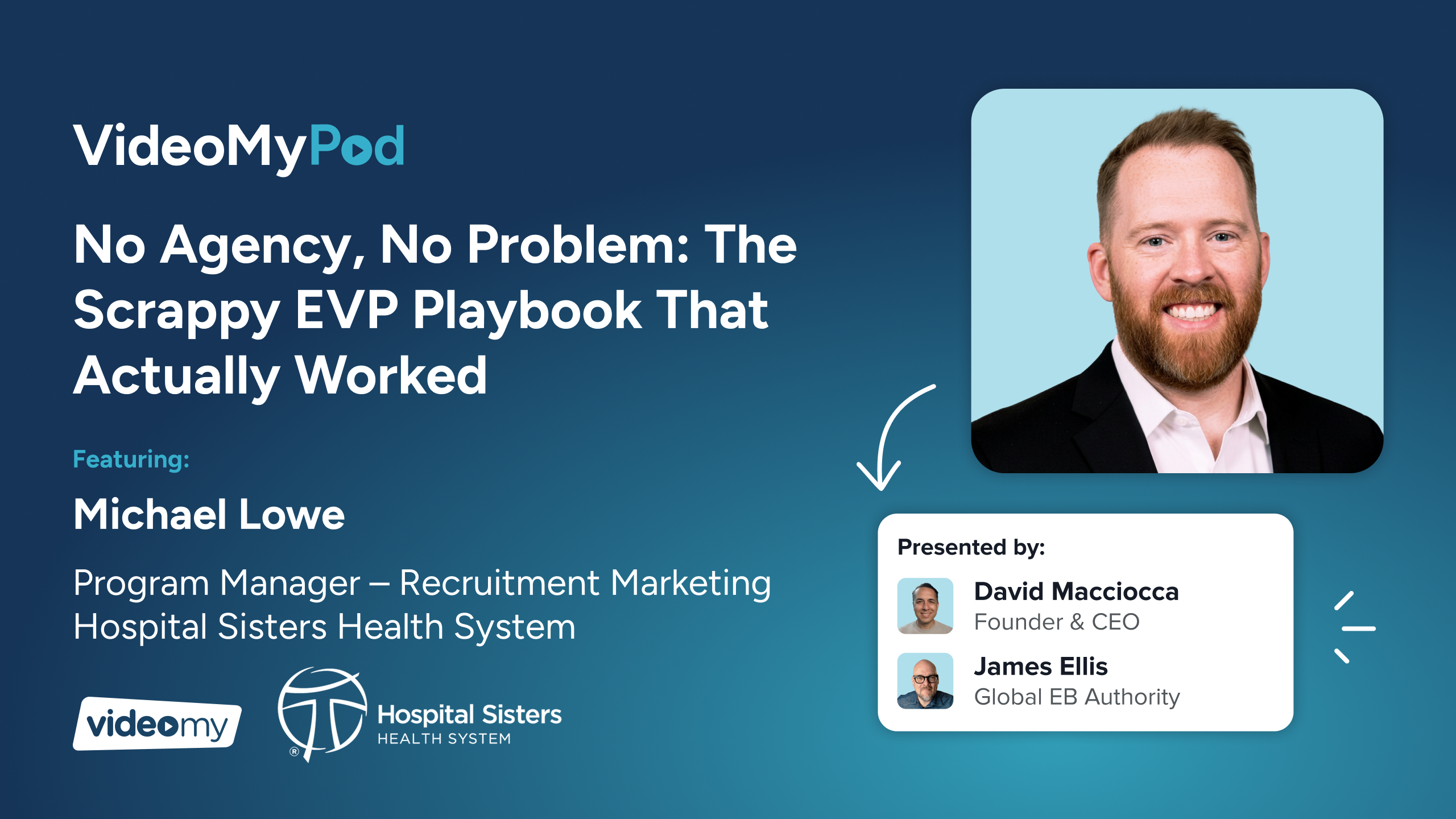
No Agency, No Problem: The Scrappy EVP Playbook That Actually Worked with Michael Lowe (HSHS)

Most organizations spend months and a bucket of money on an agency to develop an employer value proposition. Michael Lowe did it in six weeks without spending a dime on external help. Not because he's superhuman, but because he brought agency thinking into a corporate setting and realized the data organizations need to build a compelling EVP already exists inside their systems.
In this week's VideoMy Pod episode featuring co-host James Ellis, Michael shared his unconventional playbook for rapid EVP development and why speed doesn't have to sacrifice authenticity.
The Agency Advantage Meets Corporate Realities
Michael's secret sauce came from his background. Years in recruitment agencies taught him to move fast, solve problems with available resources, and work backward from business needs. "I had to take a step back and ask: how can we do this quickly without costing an arm and a leg?" he explains. "I knew I could apply what I learned in agencies, but the question was where else could I do this?"
The breakthrough came when he realized healthcare organizations are sitting on goldmines of data. Exit surveys, new hire feedback, 30/60/90-day check-ins, employee resource group surveys—all telling consistent stories about what people value, what frustrates them, and why they stay or leave. "We didn't really have time to do a lot of traditional focus groups," Michael notes. "So I took the data we already had, analyzed it, and used AI tools to validate external sentiment."
Scrappy Data Science Beats Polished Consultants
Michael's process was refreshingly pragmatic. He gathered exit survey data and new hire feedback, then used AI chatbots to test hypotheses and find external validation. "I went to ChatGPT, Claude, Perplexity, Gemini and I prompted different things. I pulled from Glass Door, Indeed, Reddit." The external research took roughly two days. Total process: six weeks.
"When people realize you're a new hire tasked with something, the 'naive card' is powerful," he admits with humor. But it's more than that. Michael proved agencies aren't magic, they're doing exactly what he did, just slower and more expensively.
The Authenticity Trap
The tension Michael faced reveals a crucial truth about modern EVPs. "I wanted it to be very authentic. But healthcare found some of that push back from the marketing team. There's a fine line between authentic and too authentic." James Ellis articulates the modern EVP dilemma perfectly: "Show the bad is not showing your dirty laundry. It's simply saying, if we are X, we are probably also Y. If we're fast, we're probably also a little chaotic."
Michael had to navigate organizational mission and vision that tenured employees live but don't discuss. "It's like asking someone to describe the air. They breathe it every day. They don't talk about it." Coming in new, he nearly skipped past the organization's foundational identity. A few gentle reminders from leadership recalibrated his approach without derailing the project.
Balancing Aspiration With Truth
The final EVP needed to feel authentic to current employees while appealing to incoming talent. Michael's solution: segment audiences. "Nursing is 50% of our staff, but the other 50% matters too. Physicians, radiology techs, corporate staff. If we only tell a nursing story, we miss half the organization."
He built the EVP with sentiments heard from current employees (what's true now) alongside aspirational elements (where the organization is moving). "Maybe 30% are saying this, maybe 70% aren't. But the organization is doing stuff to change that. So when new people come in and see those pieces, it makes sense. That 30% becomes larger because the people you're bringing in also attribute to that."
The Puzzle Pieces Fit Around One Center
Michael's closing insight is deceptively simple: "An EVP is like the center of a puzzle. Everything else (campaigns, creative, candidate stories) should be fed from that." No more random campaigns disconnected from core narrative. Storytelling becomes the amplifier, personas become the segmentation, and activation becomes inevitable.
The real value isn't just speed. It's confidence. "The EVP sets us up to focus on storytelling. Organizations get this wrong in marketing strategies. It needs to be around stories." When leadership approves an EVP on Friday and you're already brainstorming campaign ideas by Monday, that's not rushing. That's momentum.
🎥 Watch the Episode
🎧 Listen to the Podcast
.png)