Recruitment Videos: How to Attract Better Candidates and Reduce Time to Fill

Recruitment videos are short video content that shows candidates what a role, team and organisation are really like, so the right people apply and the wrong people self-select out.
The most effective recruitment videos feature real hiring managers and employees rather than actors or voiceovers, and they appear exactly where candidates make decisions: in job ads, on careers pages and in the weeks between offer and start date. Done well, recruitment videos improve quality of hire, shortens time to fill and reduces reliance on agencies.
This guide is for talent acquisition (TA) leaders and recruiters who want to use video to fix real hiring problems, not just make the careers page look nicer. We cover the types of recruitment videos worth making, where each one fits in the hiring funnel, which metrics they move and how TA teams can produce videos at scale without waiting on Marketing.
Why do recruitment videos matter now?
Hiring has become more competitive, more expensive and more scrutinised. Three shifts make video particularly valuable for TA teams:
Candidates research before they apply
Candidates no longer take a job ad at face value. Glassdoor reports that 86% of employees and job seekers are likely to research company reviews and ratings when deciding where to apply, and that 53% of job seekers look for more company information after reading a job post. If your job ad doesn’t answer their questions, they will go elsewhere to find answers, or simply not apply.
Candidates trust employees more than employers
LinkedIn found that people are 3x more likely to trust company information from employees than from the CEO. A 45-second video from the hiring manager or a future teammate is far more persuasive than another paragraph of benefits copy.
Every day a role stays open costs money
SHRM’s latest benchmarking puts the median time to fill non-executive roles at 39 calendar days. For hard-to-fill or specialist roles it is often much longer, with costs piling up through agency fees, overtime and lost productivity. Anything that brings better-fit candidates in faster has a direct financial payoff.
What are the main types of recruitment videos?
Not all recruitment videos do the same job. The most useful way to think about them is by the hiring problem they solve:
- Role spotlight videos (30-60 seconds): the hiring manager explains what the role involves, who thrives in it and where it can lead. Best for improving applicant quality and reducing screening time.
- Team introduction videos: a quick hello from the people a new hire would work alongside. Best for showing culture and helping candidates picture themselves in the team.
- Day-in-the-life videos: an employee walks through a typical day. Best for roles that are hard to explain on paper, such as frontline, technical or graduate roles.
- Career journey stories: employees explain how they’ve grown since joining. Best for attracting ambitious candidates and supporting internal mobility.
- Hiring process explainers: a recruiter walks through the stages, timelines and tips. Best for improving candidate experience and reducing drop-out mid-process.
- Location and site videos: what it’s like to work at a particular office, site or region. Best for multi-location and regional hiring.
- Preboarding and welcome videos: messages from the manager and team between offer and start date. Best for reducing reneging and early attrition.
Where does each video fit in the hiring funnel?
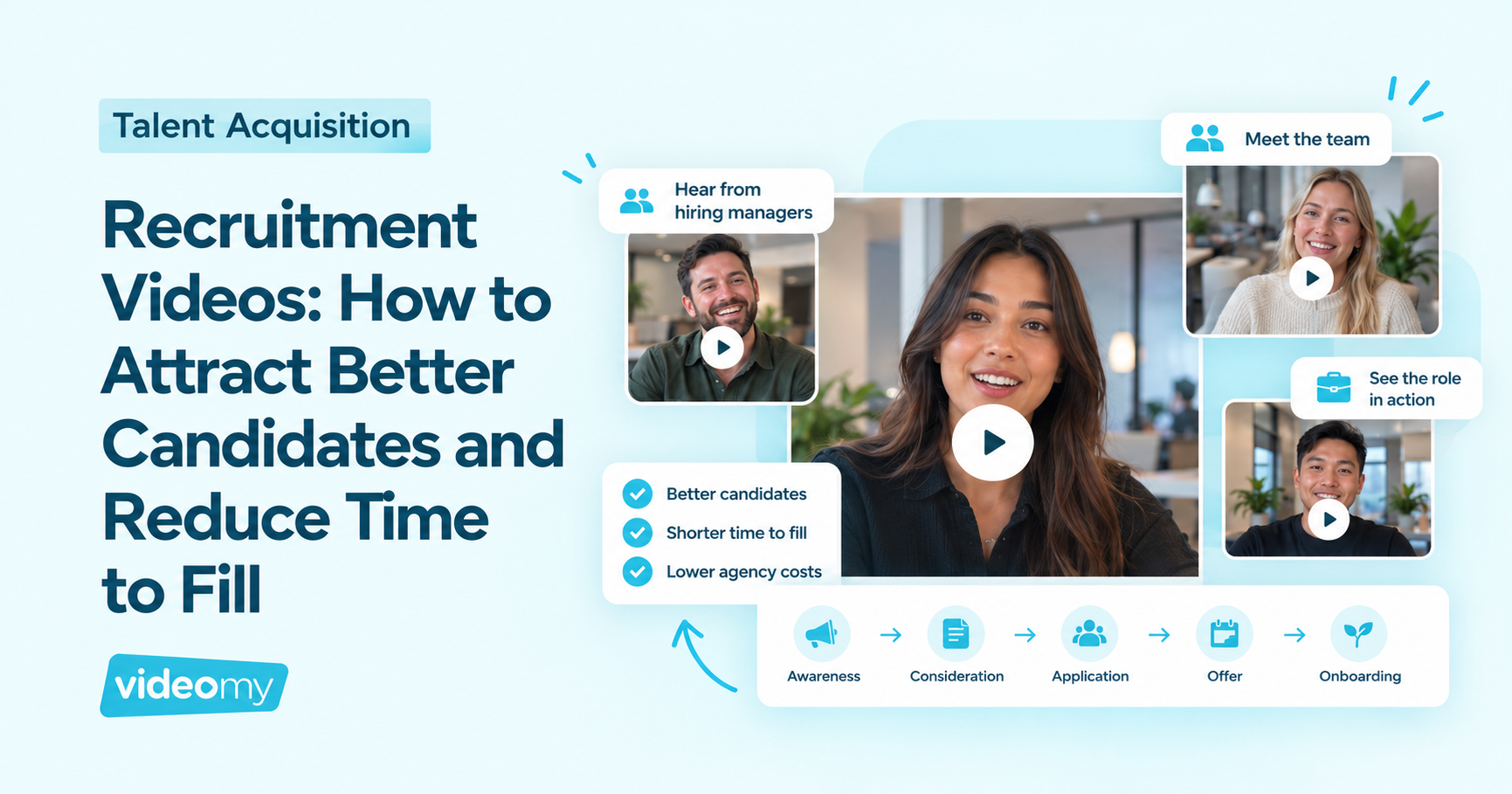
The biggest mistake TA teams make with video is creating one generic culture video and using it everywhere. Instead, match the video to the decision the candidate is making at each stage:
- Awareness (“Would I want to work here?”): culture, team and career journey videos on LinkedIn, social channels and your careers site.
- Consideration (“Is this role right for me?”): role spotlight and day-in-the-life videos embedded in job ads and role pages. This is where video has the biggest impact on applicant quality.
- Application (“What happens next?”): hiring process explainers in confirmation emails and on the careers site.
- Offer and preboarding (“Did I make the right choice?”): welcome videos from the manager and team, sent between offer and start date.
- Onboarding (“Do I belong here?”): team intros and leader messages that help new starters settle in faster.
How do recruitment videos improve hiring outcomes?
Recruitment videos are only worth the effort if they move the metrics TA is measured on. Here’s how they connect to each key metric:
Quality of hire
Video gives candidates a realistic preview of the role, so people who wouldn’t enjoy the work self-select out and those who would are more motivated to apply. This is backed by decades of research into realistic job previews (RJPs): a meta-analysis of 40 studies published in the Academy of Management Journal found that realistic job previews were associated with lower attrition during recruitment, lower turnover and higher performance. Video is one of the most efficient ways to deliver a realistic preview at scale.
Time to fill
Better-fit applicants mean less time screening people who aren’t right, fewer interview rounds and fewer re-advertised roles. For hard-to-fill roles, an employee-led story is often what convinces a passive candidate to take the next step.
Cost per hire
When your own content brings in strong candidates, you rely less on agencies and paid job boards. LinkedIn research found that a strong employer brand can reduce cost per hire by 50% and turnover by 28%. Recruitment videos built from employee stories are some of the most direct assets TA can use to strengthen the employer brand without a separate brand budget.
Offer acceptance and early retention
Candidates who have already “met” their manager and team on video are more confident in their decision. Welcome and preboarding videos keep that connection going during the riskiest period, between offer and start date.
Reach
Employee videos travel further when the people in them share them. LinkedIn data shows that a company’s collective employees have, on average, 10x more connections than the company has followers, which gives every role spotlight a built-in distribution channel.
What do candidates want to see in recruitment videos?
Candidates want honesty and specifics, not slogans. In a Zety survey of US Gen Z workers, employee day-in-the-life videos were cited by 50% of respondents as content that would make them more likely to apply, alongside workplace culture (61%). Across all age groups, the questions candidates most want answered are practical ones:
- What will I actually do day to day?
- Who will I work with, and who will I report to?
- What does success look like in the first six months?
- How flexible is the role, really?
- Where could this role lead?
- What is the hiring process, and how long will it take?
Build your video prompts around these questions and you will cover most of what candidates need to decide.
How can TA teams produce recruitment videos without an agency?
Traditional video production doesn’t work for recruitment. It’s too slow for live roles and too expensive to create a video for every vacancy. The answer is a self-serve model where hiring managers and employees record short videos themselves, within guardrails set by TA and Marketing:
- Start with your highest-impact roles. Pick 5-10 roles that are high-volume, hard to fill or have high early attrition.
- Give hiring managers a simple brief. Four prompts are enough: what the role is, who thrives in it, what the team is like and where it can lead.
- Keep it short. 30-60 seconds for role spotlights. Recording on a phone is fine; authenticity matters more than polish.
- Use brand-safe templates. Branded intros, captions and lower thirds make every video look consistent, so Marketing is comfortable and TA can move fast.
- Build an approval step. A quick review before anything goes live protects the brand without slowing things down.
- Publish everywhere the candidate is. Embed videos in job ads, role pages, LinkedIn posts, recruiter InMails and confirmation emails.
- Reuse and refresh. Build a library so videos can be reused for similar roles and updated when teams change.
This approach turns recruitment video from a one-off project into an always-on capability. For more on the employee-generated model behind it, see our comprehensive guide.
How do you measure the ROI of recruitment videos?
Measure videos against the hiring problem you set out to solve, comparing roles with video to similar roles without it:
- Attraction: job ad views, click-through and apply rate for roles with video.
- Quality: proportion of applicants reaching shortlist and interview, plus hiring manager satisfaction with the shortlist.
- Speed: time to fill and time to shortlist.
- Cost: agency usage and paid advertising spend per hire.
- Conversion: offer acceptance and reneging rates.
- Retention: turnover in the first 6-12 months.
Common objections (and how to answer them)
- “We don’t have time to make videos.” A role spotlight takes a hiring manager about ten minutes. That is far less time than re-screening a pile of poor-fit applicants.
- “Marketing owns brand content.” Brand-safe templates and approval workflows (like the ones built into VideoMy) keep Marketing in control of the brand while TA controls the speed.
- “We need our EVP sorted first.” Employee stories often help uncover your real EVP themes. Start with roles now and let the EVP evolve alongside.
- “Our hiring managers won’t want to be on camera.” Start with the willing ones. Once others see the results in their colleagues’ shortlists, participation grows.
- “We don’t have budget.” Start with a low-cost pilot on a handful of hard-to-fill roles and measure the difference.
How VideoMy helps Talent Acquisition teams
VideoMy is an employee-generated video platform that lets TA teams create recruitment videos at the speed of hiring. Hiring managers and employees record short videos from any device using guided prompts, while brand-safe templates and approval workflows keep Marketing comfortable.
Videos can be embedded in job ads, published to a Story Feed on your careers site and translated for teams in different regions, all from one central library. The result is better-fit candidates, faster shortlists and less agency spend, without adding a production project to your recruiters’ workload.
Book a demo with the team to see it in action.
Frequently asked questions
What is a recruitment video?
A recruitment video is a short video designed to attract candidates to a role or organisation. The most effective ones feature real hiring managers and employees talking about the job, the team and the culture.
How long should a recruitment video be?
Role spotlights work best at 30-60 seconds. Day-in-the-life and career story videos can run to 90 seconds or two minutes. On social channels, shorter is almost always better.
Do videos in job ads increase applications?
Video helps candidates understand the role, which tends to increase applications from well-suited candidates and reduce applications from those who aren’t. The goal is better applicants, not just more of them. Test it by comparing similar roles with and without video.
Should hiring managers or recruiters appear in recruitment videos?
Hiring managers and future teammates are usually the most persuasive, because candidates want to hear from the people they will actually work with. Recruiters are well placed to explain the hiring process.
Can we make recruitment videos without a production team?
Yes. With guided prompts, branded templates and an approval step, hiring managers and employees can record high-quality recruitment videos on their phones in minutes.
Sources
- Glassdoor for Employers: Employer Branding 101: Why, How and Proven ROI
- Glassdoor: The essential employer branding statistics you need to know
- LinkedIn Talent Blog: 7 Stats That Prove Your Employees Are Your Secret Recruiting Weapon
- LinkedIn Talent Blog: Employer Brand Impacts Your Marketing and Drives Job Consideration
- SHRM: Recruiting Benchmarking
- Phillips (1998), Effects of realistic job previews on multiple organizational outcomes: A meta-analysis, Academy of Management Journal
- Zety: Gen Z Career Trends Report