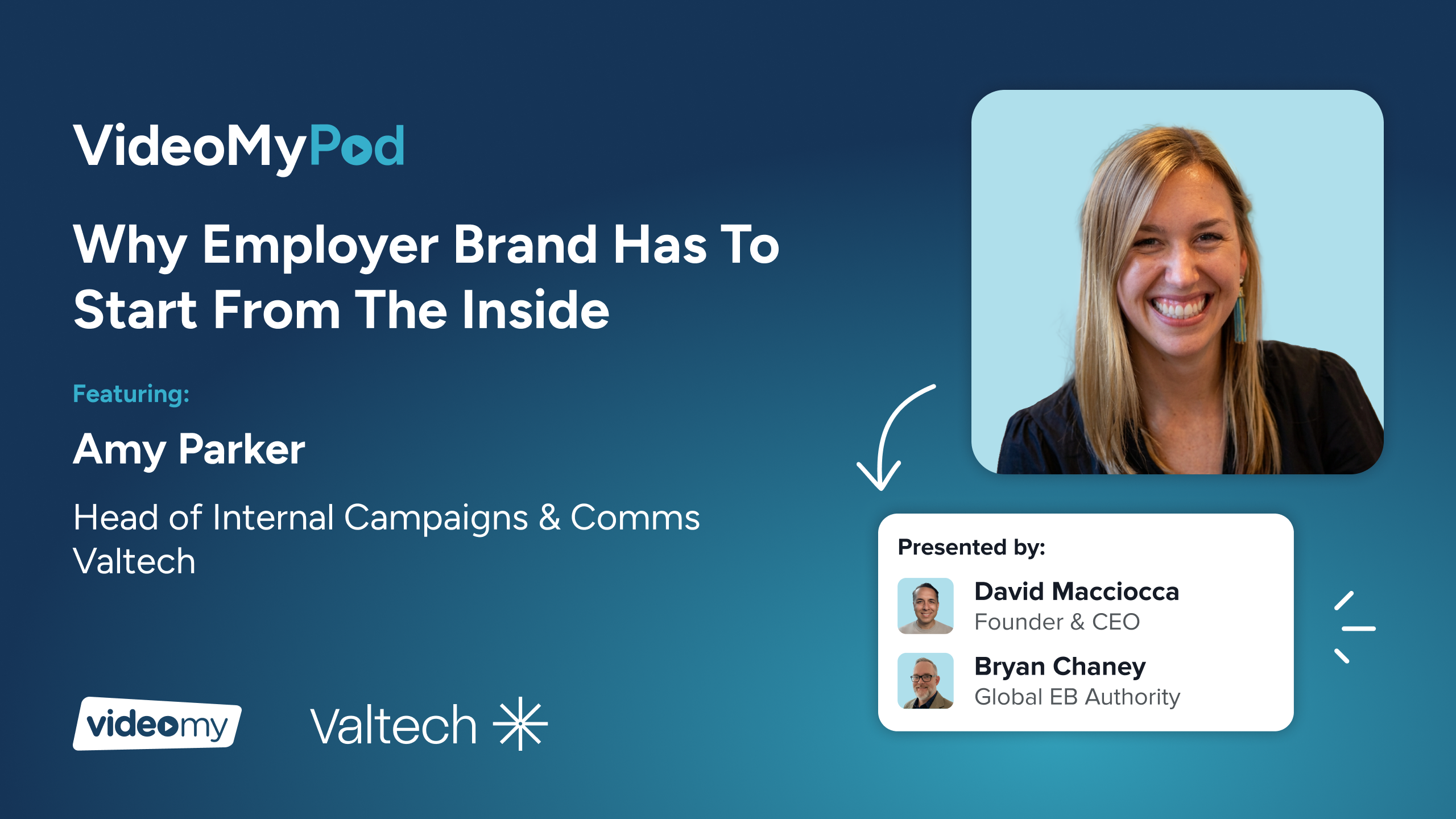
How To Activate An Ambassador Program Using What You Already Have with Carrie Corbin (Hope Leigh Marketing)


Carrie Corbin has spent more than 20 years in employer brand, leading talent brand work at AT&T, American Airlines, Samsung and Dell before starting her own recruitment marketing and employer brand agency. On the VideoMy Pod, she went deep on ambassador programs, and her main point is reassuring: most companies don't need to build one from scratch, because the pieces are already there.
Why Employee Voices Beat the Executive Video
Candidates have learned to tune out the polished leadership message. "The job seekers don't want to hear from the leaders," Carrie says. "They want to hear from people that are like them. They want to hear from their peers."
When candidates research your company and find stories "coming from the people that actually do the work as opposed to the figureheads that are telling them what it's like to work there," the message hits much harder.
Start With What You Already Have
When a client says they want an employee advocacy program, Carrie asks two questions first: do you have an employee referral program, and do you have employee resource groups? "If you have an employee referral program, you already have ambassadors," she explains.
At AT&T, a little research showed her "there were like six things that we were already doing." Her advice: "You don't always have to go build a fancy business case and go build a fancy program and build a bunch of SOPs. It is leveraging what you already have."
Make ERG Partnerships a Win-Win
Carrie's view of ERGs changed when she joined one herself and later helped lead one. She saw that the person running communications for an ERG "might actually be a finance person in their day job" who doesn't know what to post.
So her team helped ERGs with content and engagement, then ran leaderboard competitions for sharing jobs, with prizes such as $5,000 toward an ERG's scholarship fund. She was careful to respect their independence, though: "We were very careful to not be dictating their work... really wanted it to have that organic feel to it."
Recognition Is the Real Fuel
Incentives only go so far. "Dangling the carrot only works so much," Carrie notes. What keeps people coming back is visibility. She kept a list of enthusiastic employees and showed them where their content ended up, from billboards to careers videos. "Then they're excited about that, they're going to want to go share it with their friends and family."
At American Airlines, she turned a gala for 5,000 military guests into a recruiting moment. "There's so many cool experiences that nobody was talking about," she says.
Tell the Good, the Bad and the Uniquely You
Relying only on your most engaged employees can make your company look like "a bunch of shiny happy people." Carrie's fix is variety. At AT&T, realistic job preview videos showed technicians carrying 75-pound ladders into attics in the Dallas summer heat. "If I can make the job sound as ugly as possible and you still want to work here, you're going to be a lot more likely to stay."
Lower the Friction, Build the Business Case
On referrals, Carrie points to Google's experience: paying people more never moved the needle. Making it easier did. Her team's no-payout program hit a 30–35% referral rate, and one line in referral emails asked for a 30-second video or testimonial too.
The ROI case is simple: more applicants and hires with less spent on advertising. "If I can drive organic traffic and I don't have to spend all those dollars on the more expensive advertising, that to me feels like the easy business case."
🎥 Watch on YouTube
🎧 Listen on Spotify