How to Scale Employee Content Without Losing Brand Control

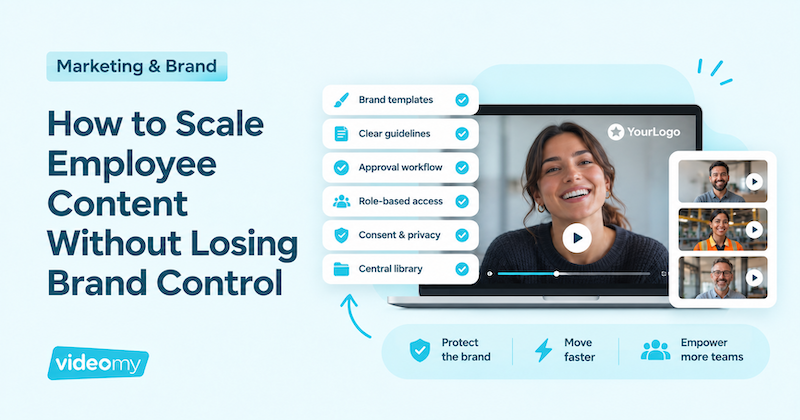
To scale employee content without losing brand control, Marketing needs to stop being the producer of every piece and become the owner of the system: brand-locked templates, clear guidelines, an approval workflow, role-based permissions, a consent process and a central library.
With those guardrails in place, Talent Acquisition, Employer Brand, HR and Internal Comms teams can create authentic content themselves, while Marketing keeps control of how the brand looks, sounds and shows up.
This guide is for marketing and brand leaders who are being asked to support more teams with more content than they can deliver. It sets out a practical governance framework you can put in place in weeks, not months.
Why is Marketing becoming a content bottleneck?
Demand for content has exploded, and it isn’t just coming from marketing campaigns. Talent Acquisition needs videos for job ads. Employer Brand needs EVP stories. Internal Comms needs leadership updates. Graduate teams need a full season of content. All of it lands on the same central team.
- Content demand is multiplying. Adobe research with more than 1,600 marketers found that 71% expect content demand to grow more than five times by 2027. In Australia, 63% of marketers anticipate their content needs will grow at least fivefold.
- Budgets are not keeping up. Gartner’s 2025 CMO Spend Survey found marketing budgets flat at 7.7% of company revenue, with 59% of CMOs saying they have insufficient budget to execute their strategy and 39% planning to cut agency budgets.
- Audiences want authenticity, not polish. Consumers are 2.4x more likely to say user-generated content is authentic compared to brand-created content, according to a Stackla survey. The content that performs best is increasingly the content Marketing doesn’t create itself.
The result is a familiar tension. Other teams want to move faster and create their own content. Marketing wants to protect the brand. Without a system, one side has to lose.
What are the risks of ungoverned employee content?
When teams create content without guardrails, the problems are predictable:
- Inconsistent branding: different logos, colours, fonts and messaging across teams and regions.
- Off-message content: claims, language or topics that don’t reflect the brand or values.
- Legal and privacy risk: people filmed without consent, confidential information in the background, or customer data on screen.
- Content sprawl: videos scattered across phones, shared drives and personal accounts, impossible to find, reuse or remove.
- Lost value: good content that never gets used because nobody knows it exists.
Brand consistency matters commercially, too. A widely cited Lucidpress study found that consistent brand presentation can increase revenue by up to 23%.
The six-part governance framework for employee content
Good governance makes it easier for people to create the right content, not harder. These six components work together:
1. Brand-locked templates
Templates are the single most effective control. Lock the elements that must be consistent (logo placement, colours, fonts, intro and outro, lower thirds, caption style) and leave the content itself to the contributor. Every video then looks like it belongs to your brand, even when it was recorded on a phone in a warehouse.
- Create a small set of templates for common uses: role spotlight, team intro, employee story, leadership update, event recap.
- Build in captions by default for accessibility and sound-off viewing.
- Include approved music and graphics so contributors don’t source their own.
2. Simple, practical guidelines
Most brand guidelines are written for designers and agencies. Employee contributors need a one-page version they will actually read:
- Do: be yourself, keep it short, film in good light, speak to one person, tell a specific story.
- Don’t: share confidential information, show customer data or screens, film people without their consent, make promises about pay or promotion, use unapproved music.
- Tone: a few lines on how the brand sounds, with examples.
3. Guided prompts instead of scripts
Give contributors questions to answer rather than scripts to read. Prompts keep content on-message (because you choose the questions) while keeping it authentic (because the answers are the employee’s own). For example: “What surprised you most when you joined?” or “What does a good day in your role look like?”
4. Approval workflows
Nothing should be published without review, but review shouldn’t take weeks. Design a workflow that matches the level of risk:
- Light-touch review for low-risk internal content, handled by the team that requested it.
- Brand review for external content such as careers site, job ads and social, handled by Employer Brand or Marketing.
- Additional review for sensitive topics such as change announcements, regulated industries or anything involving customers.
Set a target turnaround (for example, two working days) so approval doesn’t become the new bottleneck.
5. Role-based permissions
Decide who can do what. Typically: contributors can record and submit; team owners can request content and manage their projects; reviewers can approve or reject; and Marketing administers templates, guidelines and publishing destinations. Permissions let teams move independently while Marketing retains overall control.
6. A central library
All content should live in one place, tagged by team, location, role, topic and consent status. A central library stops content sprawl, makes it easy to reuse good content across channels, and lets you quickly find and retire a video when someone leaves or a message changes.
How should you handle consent and privacy?
Employee content features real people, so consent needs to be clear and documented. As general good practice:
- Get explicit, written consent from everyone featured, explaining where the content will be used and for how long. If your company has a release form template, this will usually cover what you need.
- Make participation genuinely voluntary. Employees should never feel pressured to appear.
- Set a clear policy for leavers, including whether and when content is removed after someone leaves.
- Be careful with backgrounds. Check for confidential information, customer details or people who haven’t consented.
- Store consent with the content, so you can always show who agreed to what.
Every organisation will be different when it comes to privacy and consent requirements so it’s a good idea to check with your HR team first to understand what is necessary.
How do you roll out employee content governance?
- Audit current demand. List which teams are asking for content, what they need and how often. This builds the case and shows where to start.
- Agree ownership. Confirm who owns templates, guidelines, approvals and the library. Usually Marketing or Employer Brand.
- Build the essentials. Three to five templates, a one-page guideline, a prompt bank and a consent process.
- Pilot with one team. Talent Acquisition or Employer Brand is usually the best starting point, because demand is high and results are measurable. Sales or Marketing can also be a good place to start, as they are often more comfortable in front of a camera.
- Review and adjust. After four to six weeks, check approval times, content quality and participation, and refine.
- Expand. Roll out to Internal Comms, graduate teams and regional teams, reusing the same framework.
How does governed employee content help Marketing?
- Fewer ad-hoc requests: teams self-serve instead of queuing for Marketing’s time.
- More content, same resources: output grows without adding headcount or agency spend.
- Stronger reach: employees share content they appear in. LinkedIn found a company’s combined employees have, on average, 10x more connections than the company has followers, and employee re-shares get over 2x the click-through rate of the original company post.
- Brand consistency at scale: every piece uses approved templates and passes review.
- Better visibility: Marketing can see all content across the organisation in one place.
To learn more about how employee content supports employer branding see our comprehensive guide.
What should you measure?
- Output: number of videos created and published per month, by team.
- Speed: average time from request to publish, and approval turnaround.
- Compliance: percentage of content using approved templates, and number of pieces rejected or edited at review.
- Participation: number of active contributors and teams.
- Performance: views, engagement and downstream outcomes such as applications or intranet engagement.
- Efficiency: reduction in agency spend and ad-hoc requests to Marketing.
How VideoMy helps Marketing stay in control
VideoMy is built so Marketing can set the guardrails while other teams create content themselves. Brand-locked templates keep every video consistent, guided prompts keep content on-message, approval workflows and role-based permissions control what gets published, and a central library keeps all content organised and searchable.
Approved content can be published to Story Feeds on your careers site and intranet, or shared across social channels. Talent Acquisition, Employer Brand and Internal Comms get the speed they need, while Marketing keeps control of the brand.
Book a demo with the team to learn more.
Frequently asked questions
Who should own employee-generated content?
Usually Marketing or Employer Brand owns the system (templates, guidelines, approvals and library), while individual teams such as Talent Acquisition and Internal Comms own their own content requests and projects.
How do you keep employee videos on-brand?
Use brand-locked templates for visual elements, give contributors prompts rather than scripts, provide a short do-and-don’t guide, and review content before it is published.
Does an approval process slow everything down?
Not if it is designed well. Match the level of review to the level of risk, set target turnaround times, and let low-risk internal content go through a lighter process.
What should employee video brand guidelines include?
Template rules, a short list of dos and don’ts, tone of voice guidance, what not to film (such as confidential information or customer data), consent requirements and where content may be published.
Is employee-generated content risky for regulated industries?
It can be managed. Add an extra review step for regulated topics, provide clear guidance on what can and can’t be said, and keep a full record of approvals and consent.
Sources
- Adobe: Research finds demand for content will grow 5x by 2027
- Adobe: Australian marketing teams brace for more than 5X growth in content demand by 2027
- Gartner: 2025 CMO Spend Survey Reveals Marketing Budgets Have Flatlined at 7.7% of Overall Company Revenue
- Social Media Today: Survey Reveals How Consumers Really Judge Brand Authenticity (Stackla)
- Inc.: If You Want to Make 23% More Money, Then Get Consistent (Lucidpress research)
- LinkedIn Talent Blog: 7 Stats That Prove Your Employees Are Your Secret Recruiting Weapon
- OAIC: Australian Privacy Principles