Being Choosable: Uncomfortable Employer Branding Truths with James Ellis (Employer Brand Labs)

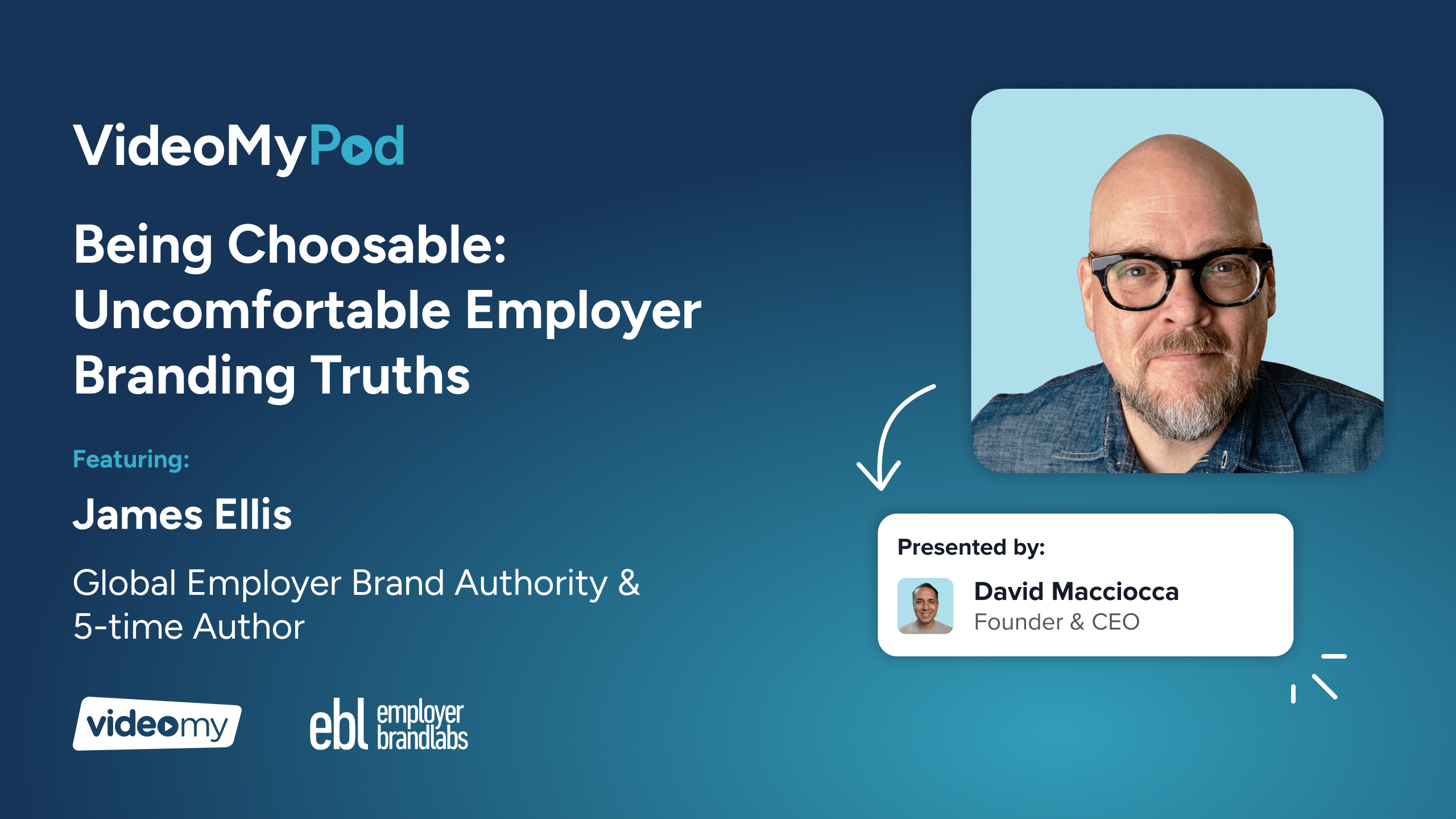
James Ellis has given thousands of employer brand pitches. When a CEO looks skeptical or a CFO asks "why should we invest in this," James knows exactly what's going wrong: leadership has seen mediocre EVPs before. They've spent $200,000 on a deck that gathers dust. They've read the Harvard Business Review calling employer branding a waste. His job is different: prove they're wrong, and do it in 60 seconds.
The Strategy: Acknowledge Their Skepticism First
"The strategy is real simple," James explains. "Chances are they've seen that Harvard Business Review article saying employer branding is unnecessary. Perhaps they've been in a company that spent $200,000 on an EVP and got a deck that was really long and didn't say much. So they have all this built-in expectation of what employer brand is. And the problem is it's not true."
Step one: show you understand why they're skeptical. This immediately builds credibility. You're not dismissing their experience, you're validating it while correcting the record.
The Real Problem: Why People Choose You
Here's the opening that reframes everything: "The people you want to hire have choices. They can choose you, but they can choose hundreds, if not thousands of other companies. And I don't know if you've looked at your career site, but it looks remarkably the same as everybody else in your industry."
That's the real EVP problem. "As a candidate, all these companies sound the same. Why are they choosing you? That's your EVP. Your EVP answers why should someone choose you over other companies."
Most organizations delegate this to recruiters. "Should your recruiters do this? No. They're busy managing the process," James says. That's where the EVP lives. Not in a recruitment playbook, but as a differentiated business story that explains why someone would choose you.
The CFO Conversation: Cut the Fluff
When talking to a CFO, skip the big ideas. Go straight to competition. "I want you to pick the three, four, five competitors we're terrified of," James suggests. Then analyze: "They say this, this, and this. We say this too."
The problem becomes visual and undeniable. "You have to make it crystal clear that if you were hiring someone amazing, why would they pick any one of these companies, let alone you?" If you can't answer that, you need to say something others can't.
But here's the CFO language: "If you don't compete on salary premiums, you have to tell a story that no one else is telling." This is cost avoidance dressed in business speak. An EVP saves money by preventing salary escalation wars for talent.
The Career Site Mistake That Makes James "Murderously Mad"
James has a pet peeve: 90% of career sites start with "Jobs At." "That's like Dickens writing 'A Tale of Two Cities' and opening with 'There were two cities.' You're wasting the most valuable real estate you own," he says. "Set the frame for how I see everything else I'm about to see."
Your career site is an asset you control; not like LinkedIn, not like Indeed. "Tell me something about your company that I'm not going to see anywhere else. That is such a huge wasted opportunity and it makes me murderously mad."
Employee Advocacy Is the Untapped Goldmine
Most employer branders post LinkedIn content themselves and move on. James sees it differently: "This is such a huge resource and it's such a huge opportunity."
The benefits cascade: "One, it makes more people like you, which sounds stupid, but you want more allies in the company. Two, you simply can't know the language a doctor cares about in the same way a nurse would use it. You can't be credible in those languages. But if you ask people to tell their own stories and talk in their own language, now you're engaging and resonating with similar people."
Then the network unlock: "Do you know how hard it is to find 50 doctors on LinkedIn? Try it. But if you find one doctor and ask them to share a story and they share it with their network, hundreds of doctors that you would pay thousands to reach will get it for free. Tell me where the downside is."
What James Believes About the Future
In rapid-fire agrees and disagrees, James laid out his convictions: EVPs aren't dead (they're being reinvented), career sites aren't irrelevant (they're becoming headless and LLM-driven), candidates don't trust corporate content (but that's still the tent pole), and AI will make most employer brand content look the same (because companies don't know how to sound different).
His most passionate agreement: "Employer brand should report directly to the CEO. Yes, please. I don't know anybody's actually done that, but agree."
🎥 Watch on YouTube
🎧 Listen on Spotify